

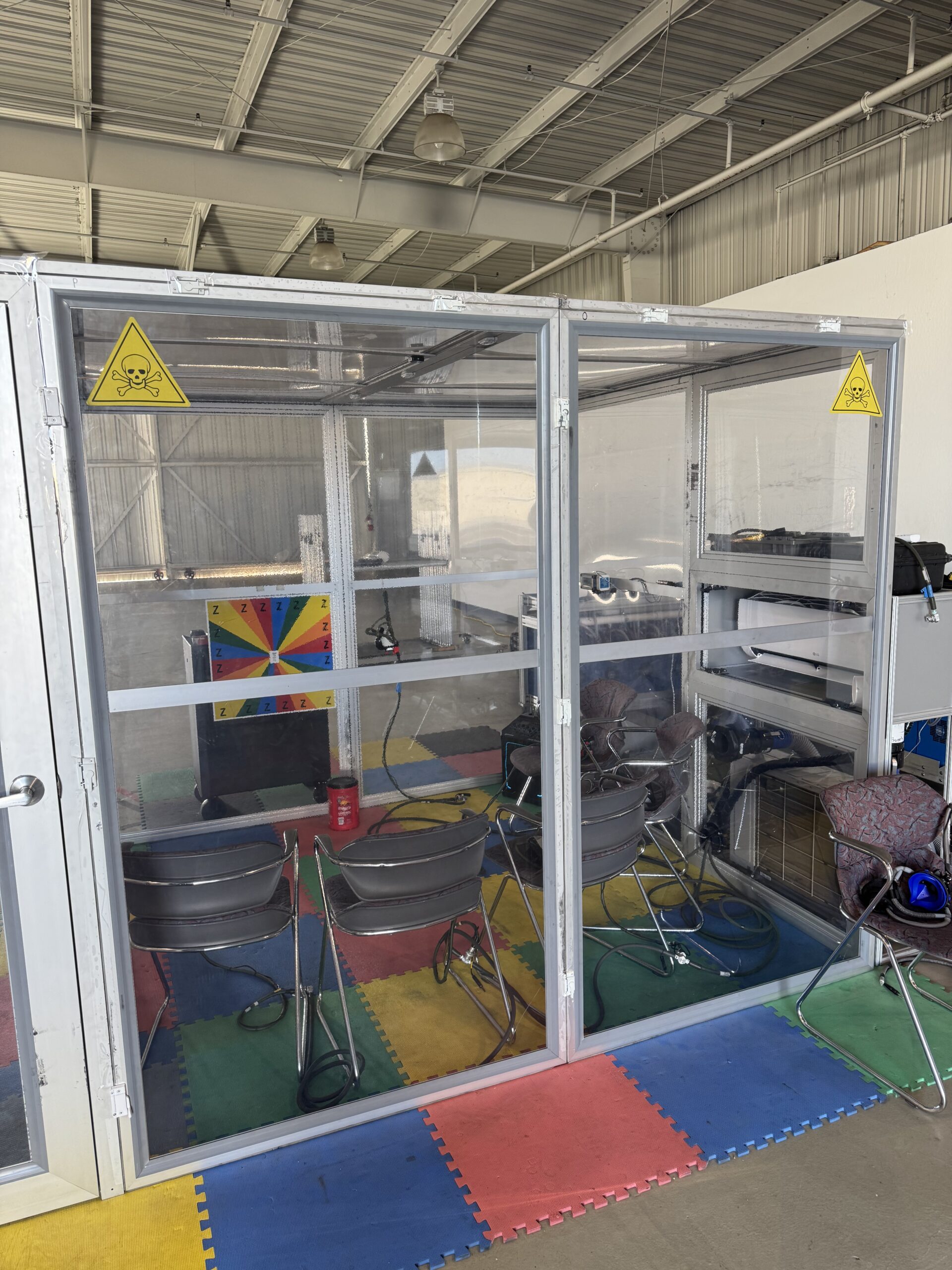
Hypoxia Recognition Training: Inside the FAA’s PROTE Chamber
In a previous article, I discussed how hypoxia affects pilots in real-world operations and why it often goes unnoticed until performance has already degraded. If you haven’t read that piece, you can start here: Hypoxia in Practice: A Pilot’s Perspective on Human Performance.
Recently I had the opportunity to experience that phenomenon firsthand. In February, the FAA brought their Portable Reduced Oxygen Training Environment (PROTE) to San Carlos Airport. These sessions are normally extremely difficult to get into because the sign-ups at Oshkosh famously fill up around 5–6 AM within minutes, so when the opportunity appeared locally, I jumped on it. It turned out to be one of the most eye-opening human factors experiences I’ve had in aviation.
What the FAA PROTE Is (and Isn’t)
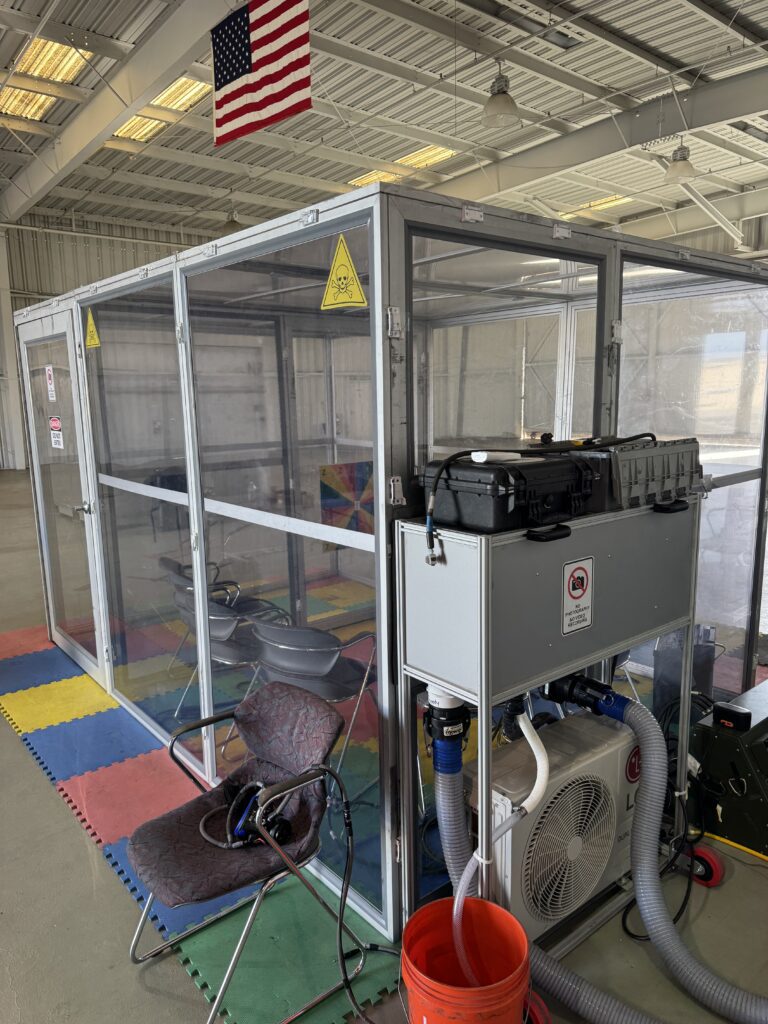
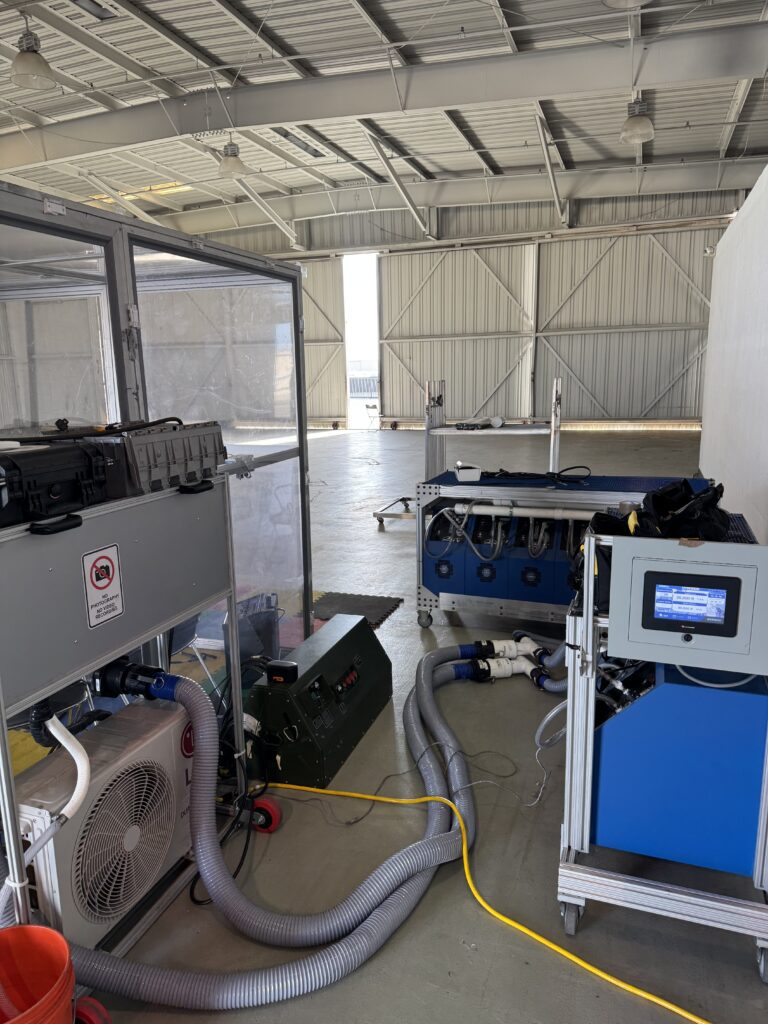
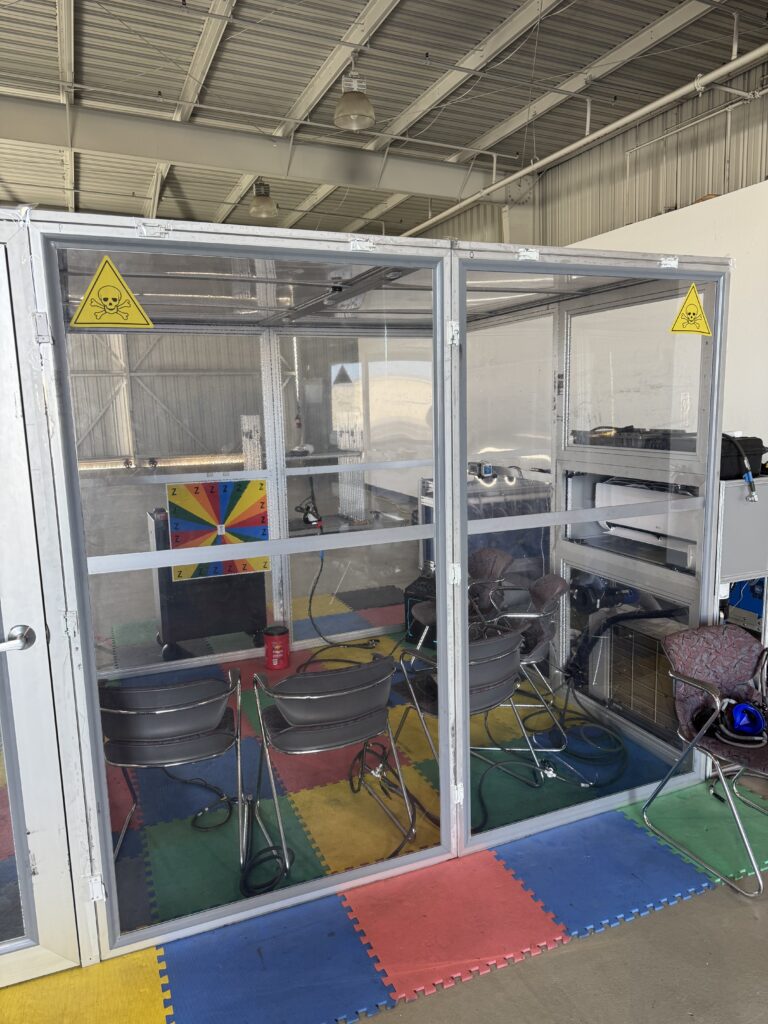
The PROTE chamber is designed to simulate a severe hypoxic environment in a controlled and safe setting. Rather than lowering atmospheric pressure like a traditional altitude chamber, the PROTE works by removing oxygen from the air. The oxygen fraction is reduced from the normal ~21% down to roughly 6%, producing a physiological effect similar to being at about FL250.
This method is called normo-baric hypoxia, and the pressure stays the same, but the available oxygen decreases. From a physiological standpoint, the result is essentially the same: the brain receives less oxygen, and cognitive performance begins to degrade rapidly.
Pilots are taught about hypoxia academically, but the PROTE allows you to experience your personal symptoms safely, which is something every pilot should do if given the opportunity.
The Briefing
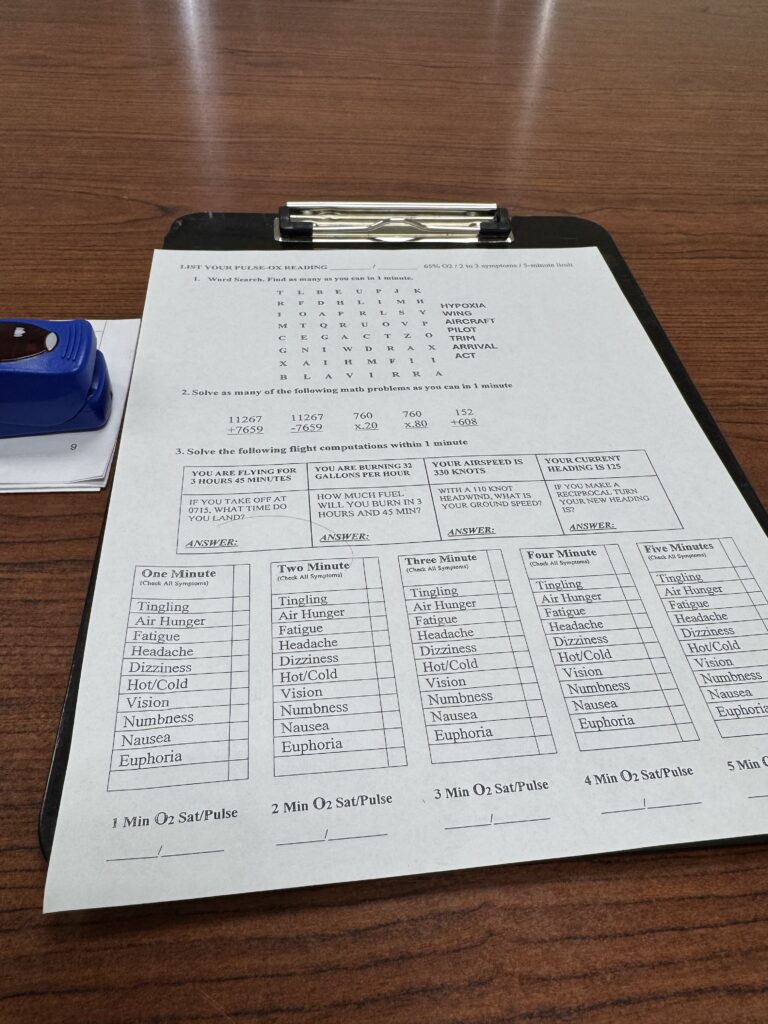
Before entering the chamber, the FAA team conducted a detailed briefing on what we were about to experience. Each participant received a worksheet containing several simple cognitive tasks:
- A word search
- Basic math problems
- Piloting questions (things like reciprocal headings and holding entries)
There was also space to record symptoms and observations, such as:
- Tingling
- Numbness
- Air hunger
- Confusion
- Euphoria
We were also instructed to record our pulse and oxygen saturation (SpO₂) every minute using a pulse oximeter. The exercise would last a maximum of five minutes. If at any point we felt uncomfortable, we could raise our oxygen mask and begin breathing supplemental oxygen. Once oxygen is restored, normal sensations return quickly.
Inside the Chamber
After the briefing, we were escorted into the chamber. The setup was simple but carefully controlled:
- Each participant had a chair, clipboard, and oxygen mask
- An FAA employee inside the chamber monitored us while breathing oxygen
- A proctor outside called out instructions and time
- Each participant had a safety observer
Before starting, we were asked to study a color wheel on the wall, paying attention to how bright and vivid the colors appeared. Then, the timer started.
Minute One: Something Feels Off
Within seconds of entering the chamber, the environment felt off. You could definitely tell that the atmosphere was different
The first task to perform was the word search. Normally this would take maybe 20–30 seconds because the puzzle wasn’t that big and there weren’t that many words to find. Instead, I found myself just staring at it. My brain felt like it had slowed down. I couldn’t visually scan the puzzle the way I normally would. Words that should have jumped out simply didn’t.
After the first minute:
- O₂ saturation: high 70s
- Pulse: 74
- Total words found: 3
Symptoms:
- Tingling
- Numbness
Already something was clearly degrading and we were only one minute in.
One symptom that surprised me was a strange sense of time distortion. It felt like time was moving much faster than normal. I would just begin working on a set of problems when the proctor suddenly announced that the minute was up and we needed to record symptoms and move on to the next section. Each time this happened it caught me off guard and it felt like I had barely started. I had never heard of time distortion as a hypoxia symptom before this experience, but during the debrief the FAA staff mentioned that time dilation or altered time perception is actually fairly common as cognitive processing begins to degrade.
Minute Two: Cognitive Performance Collapses
Next were the math problems, all simple arithmetic (addition, subtraction, multiplication).
Of five problems, I finished two and started a third. Of the ones that I did complete, both were incorrect. At this point my oxygen saturation dropped to 74%, and something more concerning appeared: air hunger and euphoria. That combination is particularly dangerous, because while my performance was deteriorating rapidly, I didn’t really care.
Minute Three: Indifference
The third section contained basic piloting questions, things like reciprocal headings or kinds of hold entries. Normally these are automatic questions that any pilot can do and I completed zero. By this point I had essentially stopped trying to answer any of the questions. I was just sitting there, feeling strangely relaxed.
Symptoms now included:
- Tingling
- Dizziness
- Euphoria
O₂ saturation: 76%.
Pulse: still normal.
From a safety perspective, this is exactly why hypoxia is so insidious. Judgment and motivation degrade along with cognitive ability. You’re becoming impaired, but the very impairment prevents you from recognizing the problem.
Minute Four: Near the Limit
The fourth minute was my last without supplemental oxygen. My O₂ saturation dropped again to 74% and my pulse increased slightly to 84 bpm.
Symptoms now included:
- Dizziness
- Nausea
- Numbness
- Euphoria
Notably, I still hadn’t raised my oxygen mask. The FAA employee inside the chamber eventually had to physically prompt me lift the mask after the proctor instructed me to do so. Outside observers noted that my face had become extremely flushed.
Vision Changes
Remember the color wheel we studied before entering? When I looked at it now, the colors looked completely different. They appeared dim, dirty and washed out. They looked nothing like the bright, vivid colors I had observed earlier. Vision degradation is a classic hypoxia symptom because the retina has extremely high oxygen demand.
Recovery
After breathing supplemental oxygen for about a minute, everything started returning to normal. The dizziness faded, clarity returned and the color wheel looked bright again. My oxygen saturation rapidly climbed back into the normal range. It was remarkable how quickly the brain recovered once oxygen was restored.
Time of Useful Consciousness
One of the most important concepts discussed during the debrief was Time of Useful Consciousness (TUC). TUC refers to the period between exposure to an oxygen-deficient environment and the point where a person can no longer perform meaningful tasks. Approximate values often cited in aviation physiology:
| Altitude | Time of Useful Consciousness |
| 18,000 ft | 20 – 30 minutes |
| 25,000 ft | 3 – 5 minutes |
| 30,000 ft | 1 – 2 minutes |
| 40,000 ft | 15 – 20 seconds |
The PROTE environment roughly simulated 25,000 feet, which is why our exercise window was limited to about five minutes. My experience matched that timeline surprisingly well because by the three to four minute mark, meaningful cognitive performance had essentially stopped.
Supplemental Oxygen Regulations
In the U.S., 14 CFR §91.211 governs oxygen use for unpressurized aircraft. The key thresholds every pilot should remember:
- 12,500–14,000 ft MSL: oxygen required for crew if exceeding 30 minutes
- Above 14,000 ft MSL: oxygen required for crew continuously
- Above 15,000 ft MSL: oxygen must be available to passengers
These regulations represent minimum legal requirements, not necessarily safe physiological thresholds. Many pilots begin experiencing measurable cognitive degradation well below those altitudes. At night, the FAA even recommends oxygen use as low as 5,000 ft, because the eye’s night vision is particularly sensitive to oxygen deprivation.
The Real Lesson
The most powerful takeaway from the PROTE session wasn’t how hypoxia felt. It was how normal it felt while it was happening. There was no dramatic moment where I thought: “I’m becoming hypoxic.” Instead, performance quietly degraded while I sat there feeling oddly comfortable about doing nothing. That’s exactly why hypoxia is so dangerous in aviation. It doesn’t feel like an emergency, until it is.
If You Ever Get the Chance, Do It
The FAA’s PROTE program is one of the most valuable human performance experiences a pilot can have. Reading about hypoxia is useful but experiencing your own personal symptoms is far more powerful. If hypoxia ever happens in the real world, whether from altitude, pressurization issues, or equipment failure, recognizing those symptoms quickly may be the difference between correcting the problem and becoming incapacitated.
After spending a few minutes in that chamber, I can say with confidence: you want to recognize it early.
Frequently Asked Questions About Hypoxia Training
What is the FAA PROTE chamber?
The FAA Portable Reduced Oxygen Training Environment (PROTE) is a mobile hypoxia training system that lowers oxygen concentration to simulate high altitude conditions.
How long can you function at 25,000 feet without oxygen?
Time of Useful Consciousness at 25,000 feet is typically 3–5 minutes, though symptoms can appear much sooner.
Is hypoxia training safe?
Yes. Participants are closely monitored and can restore oxygen immediately by using a mask.
Comments are closed