Flying the West Coast to Oshkosh: Planning a Cross-Country to AirVenture
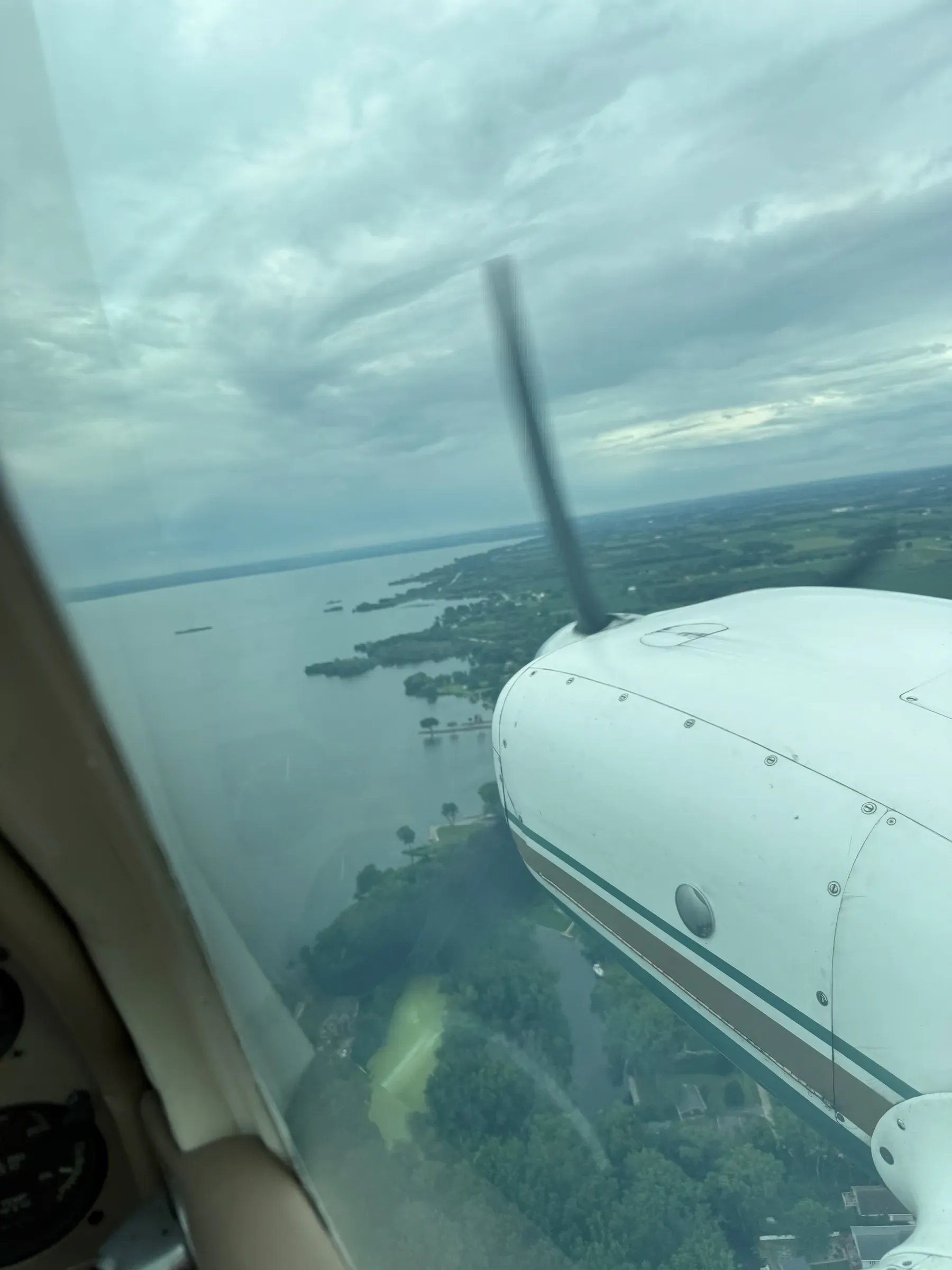
Everybody who flies wants to go to Oshkosh at least once. EAA AirVenture is the largest fly-in in the world, and there’s nothing quite like arriving in your own airplane. But if your home field is on the West Coast, getting there is a genuine cross-country undertaking — not a weekend hop.
I’ve flown my Baron from San Martin (E16) to Oshkosh, and the trip taught me more about flight planning than any single flight I’ve made before or since. Roughly 1,700 nautical miles, two mountain ranges, some of the most violent summer weather in the country, and density altitudes that will quietly eat your climb performance if you let them. Here’s how I plan it, what I’d tell a piston single driver to do differently, and the lessons I learned the hard way.
A trip like this will test every skill you have as a pilot. Navigation, flight planning, fuel calculations, communications, and above all your judgment and decision-making as pilot in command. You’ll be managing weather, terrain, fuel, fatigue, and busy airspace all at once, often under real pressure, and the airplane doesn’t care which one you let slip. This is not a flight you coast through on autopilot and habit. Fly it well and you’ll be a sharper pilot by the time you shut down at the far end.
Over the Mountains, or Around Them?
The very first decision is also the hardest: do you go over the high terrain or around it?
The direct line from the Bay Area takes you straight across the Sierra Nevada and then the Rockies. It’s shorter — less time, less fuel, less distance. But “shorter” assumes the weather and your airplane’s performance cooperate, and in the summer that’s a big assumption. Going for lower terrain — a more southern routing through the high desert, or threading the gaps — adds time, fuel, and distance, but it buys you margin: lower minimum en route altitudes, more airports underneath you, and more room to maneuver when a thunderstorm parks itself on your route.
In a turbocharged Baron I have the service ceiling to top a lot of terrain comfortably. If you’re flying a normally-aspirated piston single, this calculus is very different. A loaded 172 or Cherokee on a hot day may not have the climb performance to cross a high MEA at all, and “I’ll just climb over it” is not a plan — it’s a wish. Singles should bias hard toward the lower-terrain routing, plan around the published MEAs honestly, and never count on an afternoon climb that the density altitude won’t deliver.
Whatever you fly — single or twin — keep airports within reach the entire way. Build your route so you’re rarely far from somewhere to put the airplane down. You do not want to have a problem out over an empty stretch of high desert with nowhere to go. A few extra miles to stay near pavement is some of the cheapest insurance on the trip.
And a hard word for the twin drivers, because two engines can lull you into complacency: understand your drift-down performance, and don’t oversell it to yourself. If you lose an engine at high density altitude over the mountains, you may not be able to hold altitude on the one that’s left. You’ll drift down to a single-engine ceiling that, out here in the heat and the high terrain, can be below the rocks. A twin gives you options a single doesn’t — but over the Sierras and the Rockies on a hot afternoon, an engine failure can still put you in serious trouble. Know your real drift-down ceiling for the weight and temperature you’re actually flying, and route so that ceiling keeps you safely above the terrain.
There’s no single right answer. The right answer is the one your airplane, your loading, and the day’s weather will actually support.
Always Plan Two Routes: A Northern and a Southern Option
This is the part I want to put in bold and underline twice: plan both a northern route and a southern route before you ever leave.
Summer thunderstorms over the western United States are not the polite, scattered buildups you might be used to. They are violent. CB tops routinely reach into the flight levels 400s — well above anything a piston airplane is going to top — and they can pop up almost anywhere, almost any time of day. You cannot reliably forecast exactly where the line will set up 48 hours out.
So you don’t bet on one route. You build two: a northern option and a southern option that get you to the same fuel stops or overnight by different paths. Then, the morning of, you look at the weather and pick the one that keeps you clear. Having both already planned — frequencies, fuel, terrain, alternates — means you’re choosing between two briefed options instead of improvising a new route at 6 a.m. with a coffee in your hand.
If you only take one weather-planning habit from this article, make it this one. And if you want to understand what’s actually happening in the air column before you launch, the radiosonde and Skew-T data tells you far more about the day than a METAR ever will.
Fuel Stops: Cheap Gas Sometimes Means Small Fields
Fuel planning on a trip this long is a real optimization problem. You can find genuinely good fuel prices out there — but the cheap fuel is often at smaller airports, not the big FBOs. Sometimes that’s a great deal. Sometimes it isn’t worth it.
On our trip we stopped at Winslow (INW) in Arizona. It worked out, but smaller fields come with risk, and you have to respect it:
- Always have a backup. Small airports have surprises. The self-serve pump can be out of order, the field can be unexpectedly out of fuel entirely, or the one lineman has gone home for the afternoon. If your plan has zero margin and your fuel stop is dry, you’ve turned a fuel stop into an emergency. Plan an alternate fuel stop within range, every time.
- Call ahead when you can. A two-minute phone call beats a dead pump after a three-hour leg.
- Don’t let price override sense. Saving a dollar a gallon doesn’t matter if the field can’t actually fuel you, or if it forces a leg with no reserve over hostile terrain.
Density Altitude: Do the Math, No Exceptions
Here is where the high desert will humble you. Many of these fields sit at 4,000, 5,000, even 6,000 feet of elevation. Add a summer afternoon — 95°F, 100°F on the ramp — and your density altitude can climb past 8,000 feet before you’ve even released the brakes.
That changes everything. Your takeoff roll lengthens, your climb rate collapses, and your single-engine performance — if you’re in a twin — gets ugly fast. This is exactly the regime where losing an engine takes away far more than half your performance.
So you run the numbers. Every time. Out of every hot, high field:
- Calculate your actual takeoff and climb performance for the real density altitude, not sea-level book numbers.
- Do a real weight and balance. No exceptions. With full fuel, bags, and people, on a hot high field, you may simply not have the performance — and you need to know that on the ground, not at 50 feet.
- If the numbers don’t work, wait. Density altitude drops as the day cools. Sometimes the right move is to sit out the heat of the afternoon and depart in the cool of early evening or, better, early the next morning.
If you’re going to wait, pick a fuel stop with a decent lounge or a place to get out of the heat. Waiting out a 100°F afternoon on a baking ramp with no shade is its own kind of hazard. On a trip like this, comfort is a safety item.
Dress for It, and Take Care of Your Body
It is going to be hot. The cabin will be hot, the ramp will be hot, and the desert legs will be hot.
- Dress for the trip. Comfortable, breathable clothing. You’re going to be in the seat for hours.
- Bring water. Lots of it. Dehydration sneaks up on you at altitude and in the heat, and it degrades your decision-making long before you notice. (If you’ve read about how subtly hypoxia erodes judgment, the same principle applies — physiological stress hits your brain before it hits your awareness.)
- Bring food and snacks to keep your energy up. A blood-sugar crash three hours into a leg over the Rockies is not when you want to be making decisions.
- If you’re flying with another pilot, swap roles every hour or so. Trade off flying and managing comms/navigation. It keeps both of you fresh and engaged instead of one person grinding down over a long day.
Plan to Be Tired — and Don’t Do It in One Day
If you’re in a piston airplane, do not try to make Oshkosh in a single day. It’s roughly nine hours of flying for me in the Baron, more in a slower single, plus fuel stops, plus weather deviations. By hour seven your judgment is not what it was at hour one, and the back end of the day is exactly when the thunderstorms are at their worst.
Plan to be fatigued. Build the overnight stop into the trip from the start. Honestly, it’s one of the best parts. This is a rare chance to see parts of the country you’d otherwise fly over at altitude. On our trip we broke up the legs with a stop at River Falls (H81), a neat little airpark near Amarillo, Texas, and spent the night at Tulsa Riverside (RVS) in Oklahoma. Stretching your legs somewhere interesting — and getting real sleep in a real bed — beats arriving at Oshkosh exhausted and behind the airplane.
The payoff for stopping fresh showed up the very next morning. We launched out of Tulsa into some genuinely good actual IMC — not thunderstorms, just solid instrument conditions and rain. It was exactly the kind of benign actual you hope for: real instrument time to keep your scan sharp, with none of the convective violence that makes summer weather out west so dangerous. Well-rested and ahead of the airplane, it was a pleasure to fly. Tired and rushed, it would have been a very different morning.
En Route Discipline: Early, East of the Rockies by Noon
A few hard rules I fly by on this trip:
- Leave early. The atmosphere is calmest in the morning, before the daytime heating fires off convection. Aim to be east of the Rockies by noon, before the afternoon storms build.
- Expect turbulence in the Sierras and the Rockies. Mountain wave and thermals over high terrain make for a rough ride. Brief it, secure the cabin, and don’t fight it.
- Use flight following. Every leg. The extra set of eyes, traffic calls, and weather information is worth the radio work, especially in busy or unfamiliar airspace.
- Watch the weather constantly, and deviate when you have to. Your planned route is only a starting point. If a cell is building on your line, go around it. Early.
- Give thunderstorms a wide berth — at least 20 nautical miles. I’m serious about this number. Twenty miles keeps you clear of the gust front, the hail that can fall from the anvil well outside the visible cloud, and the wind shear that lives around these storms. Going around costs you almost nothing in time. Flying close can cost you the airplane.
The Oshkosh Arrival Is a Whole Different Animal
Everything above gets you to the area. The arrival into Oshkosh is its own challenge, and it deserves to be treated as the highest-workload flying you’ll do all trip. The famous FISK arrival packs hundreds of airplanes into a tight, precisely-choreographed procedure, and it does not tolerate improvisation.
How I set up for it:
- Start early in the morning, with full tanks. You want fuel in reserve for holds, for being sent around, and for diverting if the field goes to a hold or closes. Arriving low on fuel into the busiest airspace in the world is asking for trouble.
- Re-read the NOTAM before you launch. No matter how many times you’ve already read it — read it again that morning. The AirVenture NOTAM is the rulebook for the arrival, and it’s long for a reason.
- Highlight the FISK procedures ahead of time. Mark the important steps, the frequencies, and the visual reporting points so you’re not flipping pages at 90 knots and 1,800 feet in a conga line of traffic.
- Bring help and assign roles. Ideally you have a second person: one flies, one manages comms and the NOTAM. If you’ve got more people aboard, put them to work as traffic spotters. There are a lot of airplanes packed into a small piece of sky.
- Be ready to be sent around. It happens — controllers will break you out and have you re-enter the procedure from the beginning. It is normal. Don’t take it personally and don’t get flustered; just comply and re-sequence.
- Maintain your altitude and spacing precisely. This is not the place for sloppy airspeed or wandering altitude. The whole system works because everyone holds their assigned numbers. This is the same kind of hidden, creeping workload that catches pilots off guard on “easy” flights, except here the workload is right out in the open and there’s no room to coast.
- When it’s time to land, fly the airplane — and nothing else. Controllers will assign you a colored dot to land on. Forget about the crowds, the spotters, and the photographers lining the runway. Nail your landing dot. Fly your airplane to your spot and let the show take care of itself.
Once You’re on the Ground
Landing doesn’t end the workload. The ground operation has plenty of its own, and these are the things nobody really warns you about beforehand:
- Be ready for a lot of traffic and delays — including long stretches at ground idle. You will sit and creep along in a line of airplanes. That much idling in summer heat is hard on your engines, so watch your CHTs and lean aggressively on the ground. Don’t let cylinder temps climb while you’re stuck in line waiting on a marshaller.
- Taxi slowly on the grass. The turf taxiways and parking areas have potholes and uneven ground. Take it at a walking pace, watch your strut compression, and mind your prop tips — a prop strike from dropping a nose gear into a hole is a brutal way to end the trip.
- Bring something stiff to put under your wheels — a wood board works well. When it rains (and at Oshkosh it’s when, not if), the grass turns to mud and airplanes sink in. A board under each tire keeps you from settling into the muck overnight.
- Print your destination signs on paper. Make big, legible signs for where you’re headed — General Aviation Camping, General Aviation Parking, and so on — and hold them up where the marshallers can read them. Don’t try to use your iPad for this: the marshallers can’t see a screen in bright sunlight. Same goes for your VFR departure signs when it’s time to leave. A sheet of printer paper beats a $1,000 tablet here.
A marshaller wands us to our spot, and the Baron tied down for the week — note the board under the nosewheel to keep it from sinking into the turf.
Final Thoughts
A West Coast trip to Oshkosh is one of the most rewarding flights you can make in a light airplane, and one of the most demanding. The terrain, the summer weather, the density altitudes, and the fatigue all stack up, and the arrival itself demands real precision. None of it is beyond a well-prepared pilot, but it all comes down to preparation: two routes, honest performance numbers, real fuel reserves, an overnight stop, and a disciplined arrival plan.
Plan it like the serious cross-country it is, and you’ll have the trip of a lifetime. Cut corners, and the West will find them.
If you’re thinking about making the trip in your own twin and want a second set of eyes on the planning — routing, performance, weather strategy, or the arrival — that’s exactly the kind of thing we do at Cloud Nine Flight Services.
After all the planning and the weather and the heat and the fatigue, it is worth every bit of it. I’ll never forget my first arrival into Oshkosh: coming down the FISK arrival, heart pounding, everything I’d briefed coming together all at once, and then hearing those words over the radio:
I put it down right on the dot. And as I rolled out, the controller came back with something I’ll carry for the rest of my flying life:
“Great landing — welcome to the show.”
It got me the first time, and it has gotten me every single time since. That’s why we do all of this. See you at Oshkosh.
David Stites, MEI
Multi-engine flight instructor and professional ferry pilot in the San Francisco Bay Area.
Ready to Start Your Multi-Engine Training?
Contact me today to discuss your training goals and schedule your first lesson.
Get in Touch